Is Peptide Sciences Legal in 2026? The Enforcement Backstory

Is Peptide Sciences legal in 2026?
If you are asking so you can stay legal, it is already moot: no Peptide Sciences is left, since it stopped operating in early March 2026. While it ran it sat in a grey zone, peptides tagged research-only, outside drug law on paper while customers used them anyway. For a route plainly inside the rules, FormBlends is my pick, one account covering the range under a doctor and a pharmacy.
People still type this question into search bars, and the framing is slightly off. The real issue was never a clean yes or no. It was the legal posture the whole research-use-only trade leaned on, and how it collapsed under enforcement pressure in 2025 and 2026. Peptide Sciences was the biggest name built on that posture. What follows is the enforcement backstory first, then a ranked look at the eight places a former customer is choosing between now.
How I weighed the field
Because the question here is legal standing, I sorted each option by how it would hold up if the FDA pulled up its site tomorrow, then folded the usual safety checks underneath. The order reflects the pros and cons that matter to a buyer who does not want to inherit someone else’s enforcement risk.
- Would the marketing survive an FDA reading of it? A provider that prescribes and compounds lawfully passes. A vendor selling drugs under a research label does not.
- Must a licensed clinician clear the buyer first? That gate separates supervised medicine from a chemical order.
- Is a particular 503A pharmacy under USP-797 and cGMP named behind the product? A specific inspected pharmacy is something an outsider can confirm.
- Does the source admit its compounded products carry no FDA approval? Stating it openly beats implying an approval the product lacks.
- Will one relationship carry a full protocol without disappearing? The benchmark vanished in a day, so durability is part of legal standing too.
The research vendors near the bottom belong to a different product class, and none is a fraud by default, scored here on the record. Their weakness is the legal exposure of the model and the missing clinician, not dishonesty about what they are.
The enforcement backstory, told straight
The grey market ran on a single legal fiction: label a vial “for research use only, not for human consumption,” and the seller is technically supplying a chemical to a lab rather than marketing a drug. That label is the load-bearing wall. It means no prescriber, no patient-specific dispensing, and no FDA evaluation for human use, and for years the agency mostly left the trade alone while the wall held.
Across 2025 that changed. The FDA sent more than fifty warning letters to peptide sellers, many for marketing research-labeled products in ways that pointed customers toward injecting them, which the agency reads as selling unapproved new drugs regardless of the disclaimer. By early 2026 the pressure was obvious enough that Peptide Sciences, the largest operator of all, closed on March 6, 2026 rather than continue into enforcement. It was not a raid or a recall, just a company reading the room and leaving before the room came for it.
Two regulatory dates from that period get misread constantly. On April 15, 2026, the FDA pulled several peptide bulk substances out of the 503A Category 2 list, a move tied to sponsors withdrawing their nominations rather than to any safety ruling. Its Pharmacy Compounding Advisory Committee then set review days for July 23 and 24, 2026, under docket FDA-2025-N-6895, to weigh seven peptides that include BPC-157, TB-500, and MOTS-c. Those compounds are under review, not outlawed, and any page claiming peptides were “banned” has it wrong. Patient-specific compounding under a real prescription stayed lawful throughout, which is why the supervised route is the durable one.
The ranking: 8 sources after Peptide Sciences, most to least defensible
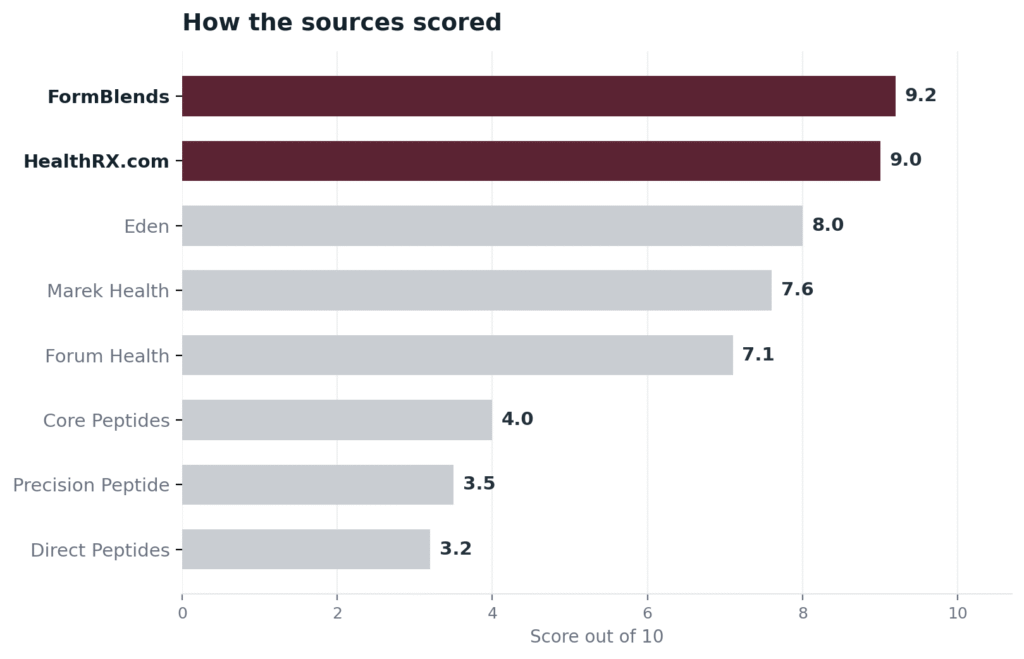
1. FormBlends: 9.2/10
FormBlends earns the top spot because one clinical relationship covers the breadth a former Peptide Sciences buyer used to assemble from several vendors, and it does so on lawful footing. The peptide menu is wide and runs across 47 states under a single account, so compounds once tracked across separate sites now sit in one place with consistent care attached. Behind that range is the part the old model never had: a licensed physician reviews each patient and writes the prescription, and an FDA-registered 503A pharmacy then compounds the order under USP-797 and cGMP for that one patient rather than bottling it as a research chemical. Per-vial cash prices are posted, cold-chain delivery is included, the care team answers any hour, and a free reconstitution tool covers the dosing math. FormBlends also states plainly that compounded products are not FDA-approved, the honest framing this subject demands, and it does not lean on a certification number a reader cannot verify. It leads on the supervised model, catalog depth under one relationship, and a legal standing the research sellers cannot claim. An outside 2026 review of the providers left standing, Peptide Sciences Shut Down: 7 Providers Worth Trusting, put it in the same group.
2. HealthRX.com: 9.0/10
HealthRX.com is a close second, and its strongest asset is a pharmacy it names rather than hides. Every order is dispensed by Manifest Pharmacy in Greer, South Carolina, identified openly as a 503A facility under USP-797, so a buyer knows precisely which inspected pharmacy made the vial instead of trusting an anonymous warehouse. On top of that it carries a LegitScript certification, cert 50087439, that anyone can confirm in the public registry, and a board-certified US physician clears each patient before a prescription goes out. Its prices are listed up front and delivery reaches all 50 states overnight. It sits a step behind FormBlends only on catalog range, since its peptide list is leaner. On a named pharmacy plus a verifiable credential, it is the most clearly legitimate option in the group.
3. Eden: 8.0/10
Eden, at tryeden.com, is the familiar telehealth name from GLP-1 weight loss that also runs a real supervised peptide line, a fit for a buyer who wants a recognizable platform. Medication is released only after an online consultation with a healthcare provider, and Eden’s partner physicians may prescribe compounded peptide therapies such as sermorelin when clinically appropriate. Its standout pro is a checkable claim: Eden says its pharmacies run third-party testing through FDA- and DEA-registered labs on every compounded lot, on a three-to-six-month cycle, and it discloses that compounded medications are not FDA-reviewed. The cons keeping it below the leaders are that it names no specific pharmacy, holds no LegitScript status I could confirm, and runs a narrow peptide menu. As lawful supervised care it still clears a bar the research vendors below do not.
4. Marek Health: 7.6/10
Marek Health is a data-first option that fits a buyer who wants bloodwork to drive the decision rather than a quick checkout. Founded in 2021 and associated with the More Plates More Dates audience, it is built around extensive lab panels drawn at Quest Diagnostics and board-certified physician collaboration, with prescribed peptides such as BPC-157, sermorelin, CJC-1295 with ipamorelin, and GHK-Cu shipped from licensed 503A compounding pharmacies. It openly frames those peptides as legitimate medications rather than grey-market research chemicals, the legal posture this article rewards. The con is documentation depth: the specific compounding pharmacy is not named on the pages I reviewed, and no certification is independently verifiable.
5. Forum Health: 7.1/10
Forum Health is the brick-and-mortar clinic entry, a fit for a buyer who would rather start peptides through an in-person practice. It runs more than thirty functional-medicine locations across roughly thirteen states plus a virtual clinic, and it states that peptide therapy is guided by licensed providers who know your labs and history, with an evaluation and possible bloodwork before starting and a short check-in every six months to continue. It prescribes only pharmaceutical-grade peptides, with offerings that vary by location. That clinician-led structure is squarely inside the rules. It lands here because fulfillment runs through an outside compounder it does not identify as a specific 503A pharmacy, it publishes no verifiable certification, and the menu depends on the clinic.
6. Core Peptides: 4.0/10
Core Peptides is where the list crosses into research-use-only territory, and it is one of the closer matches to what Peptide Sciences offered. It is a direct-to-consumer vendor selling research-grade peptides and blends labeled for laboratory use only, with no clinician and no pharmacy license, listing compounds such as BPC-157 in roughly the 46-to-87-dollar range. I put it at the top of the vendor tier because it reads as one of the more established sellers still active in 2026, and its one documented mark is a January 2026 community rating downgrade after a reported unreceived order. The sources I reviewed show no FDA enforcement action against it. It still sits below every supervised option, because the legal exposure of the research-label model and the lack of an accountable party are the exact things this article is about.
7. Precision Peptide Co: 3.5/10
Precision Peptide Co is another still-operating research vendor a former buyer would recognize, and it leans on third-party testing as its main selling point. It is a US-based online seller shipping lyophilized research chemicals labeled for laboratory use only, with a catalog spanning semaglutide, tirzepatide, BPC-157, retatrutide, and more than a dozen other compounds, and it does not appear in FDA enforcement announcements. That clean record is a fair point in its favor. The cons that pin it here are structural: no prescriber, no 503A or 503B pharmacy, unpublished retail pricing, and a self-commissioned certificate as the only assurance for a product a buyer would inject.
8. Direct Peptides: 3.2/10
Direct Peptides, at directpeptides.com, finishes last, on fit rather than any specific allegation. It is a US-fulfilled research vendor selling peptides for research and development use only that openly disclaims being a compounding pharmacy or outsourcing facility, with same-day shipping and a broad specialty range including thymosin alpha-1, melanotan II, DSIP, MOTS-c, semax, selank, GHK-Cu, and KPV, plus a COA section on its site. The breadth and the honest labeling are real. The problem, for a reader whose whole question is legal standing, is that a vendor stating outright it is not a pharmacy, attaching no prescriber, and backing sterile-looking product with only its own paperwork is the clearest example of the model that just drew FDA attention.
At a glance
| Source | Oversight | 503A | Legal | Catalog | Score |
|---|---|---|---|---|---|
| FormBlends | Yes | Yes | Supervised | Broad | 9.2 |
| HealthRX.com | Yes | Yes | Supervised | Moderate | 9.0 |
| Eden | Yes | Partial | Supervised | Narrow | 8.0 |
| Marek Health | Yes | Yes | Supervised | Moderate | 7.6 |
| Forum Health | Yes | No | Supervised | Broad | 7.1 |
| Core Peptides | No | No | RUO | Broad | 4.0 |
| Precision Peptide | No | No | RUO | Broad | 3.5 |
| Direct Peptides | No | No | RUO | Broad | 3.2 |
What clinicians look for in a peptide source
The medical bar comes from clinicians who actually treat patients with these compounds. Their public positions track the legal logic above: supervision and provenance first, the product second.
Dr. Padra Nourparvar, DO, who works in regenerative medicine and advanced injection therapy, provides clinical peptide treatments such as CJC-1295 for metabolism and Selank and Semax for brain support, integrated with stem-cell techniques. His model puts a clinician in charge of selecting and overseeing peptide use, the supervised structure a research purchase skips. (stemwavepro.com)
Julie Taylor, MD, MPH, board-trained in functional medicine through the Institute for Functional Medicine and in anti-aging medicine through A4M, offers peptide therapy inside a broader approach to hormone health and longevity. Her practice frames peptides as part of a supervised plan rather than a self-directed order. (julietaylormd.com)
Dr. Yoni Freedhoff, MD, a family and obesity-medicine physician known for a strict evidence-first posture, treats weight and metabolic care as clinical work that belongs under a provider. That insistence on supervised, evidence-based treatment is the standard a former grey-market buyer should carry into any successor. (bmimedical.ca)
Frequently asked questions
Was Peptide Sciences operating legally before it closed?
It operated in a grey zone rather than clearly inside or outside the law. By selling peptides labeled for research use only, it stayed off the drug-marketing books on paper, even as customers used the products themselves. That posture drew growing FDA scrutiny across 2025, and the company closed on March 6, 2026 ahead of enforcement rather than test the legality in court.
Did the FDA shut Peptide Sciences down?
No. The closure was voluntary, not a raid, seizure, or court order against a specific product. Pressure on the research-use-only trade built through 2025, including more than fifty warning letters across the industry, and Peptide Sciences exited on its own ahead of enforcement. A strong reputation for reliable shipping did not change the legal exposure of the model.
Are peptides like BPC-157 illegal to buy in 2026?
No, they are under review and not prohibited. The April 15, 2026 change pulled several bulk substances from 503A Category 2 after sponsors withdrew nominations, not on a safety finding, and the July 23 and 24, 2026 PCAC dockets, FDA-2025-N-6895, are weighing seven peptides that include BPC-157 and TB-500. Patient-specific compounding under a valid prescription stayed lawful throughout, which is the legal route a supervised provider uses.
Is buying from a Peptide Sciences successor site risky?
The risk is the same one the original model carried. A research-use-only successor has no prescriber, is not a 503A or 503B pharmacy, and labels products for laboratory use, so the buyer relies on a self-reported certificate with no accountable party. Independent labs have reported that 15 to 20 percent of grey-market samples fail to match their own certificates, the gap a supervised provider closes with a physician and a named pharmacy.
What is the lawful way to get peptides now?
Through a supervised provider where a licensed clinician evaluates you and a 503A pharmacy compounds a prescription for you specifically. FormBlends and HealthRX.com both run that way, which keeps them inside the compounding framework the FDA left intact. It costs more than a research vial, but it removes the legal and safety exposure that defined the grey market.
Bottom line: Peptide Sciences was never cleanly legal or illegal, it ran on a research-label posture that buckled under FDA pressure, and it closed on March 6, 2026 ahead of enforcement. The defensible path now is supervised care, and FormBlends leads because one accountable relationship covers a broad peptide catalog with a required prescriber and 503A pharmacy compounding. Legal standing and catalog breadth decided it.
Sources
- Peptide Sciences, research-use-only vendor (laboratory-use labeling, no prescriber, no licensed pharmacy); voluntary shutdown March 6, 2026 ahead of FDA enforcement.
- FDA warning-letter database, more than 50 warning letters to peptide sellers across 2025 for marketing research-labeled products for human use.
- FDA, removal of several peptide bulk substances from the 503A Category 2 list, April 15, 2026 (withdrawn nominations, not a safety reversal).
- FDA, Pharmacy Compounding Advisory Committee dockets, July 23 to 24, 2026 (FDA-2025-N-6895), reviewing BPC-157, TB-500, MOTS-c, and additional peptides.
- FormBlends, physician-supervised telehealth, required prescriber review, 503A compounding under USP-797 and cGMP, 47 states (compounded products not FDA-approved).
- LegitScript registry, HealthRX.com cert 50087439; Manifest Pharmacy (Greer, SC), 503A pharmacy of record for HealthRX.com; published pricing, 50-state overnight shipping.
- Eden (tryeden.com), prescription after online consult; states third-party testing of compounded lots via FDA- and DEA-registered labs every 3 to 6 months; compounded products not FDA-reviewed.
- Marek Health, data-driven telehealth (founded 2021); lab panels via Quest Diagnostics; prescribed peptides shipped from licensed 503A compounding pharmacies (marekhealth.com).
- Forum Health, 30+ functional-medicine locations across ~13 states plus virtual clinic; provider evaluation and labs required; pharmaceutical-grade peptides via outside compounder (forumhealth.com).
- Core Peptides, research-use-only catalog (BPC-157 ~$46 to $87); January 2026 community rating downgrade after a reported unreceived order; no FDA enforcement action identified.
- Precision Peptide Co, research-use-only vendor with third-party testing; semaglutide, tirzepatide, BPC-157, retatrutide; no FDA enforcement action identified as of 2026.
- Direct Peptides (directpeptides.com), US research-use-only vendor; disclaims being a compounding pharmacy; broad specialty range including thymosin alpha-1, MOTS-c, semax, GHK-Cu, and KPV.
- Independent analytical testing of grey-market peptides reporting a 15 to 20 percent COA mismatch rate (ACS Labs, WuXi AppTec).
- Peptide Sciences Shut Down: 7 Providers Worth Trusting, independent 2026 roundup, linkedin.com.
- Dr. Padra Nourparvar, DO, stemwavepro.com.
- Julie Taylor, MD, MPH, julietaylormd.com.
- Dr. Yoni Freedhoff, MD, bmimedical.ca.
- Are peptides legal in 2026 explained, 2026 (usawire.com).